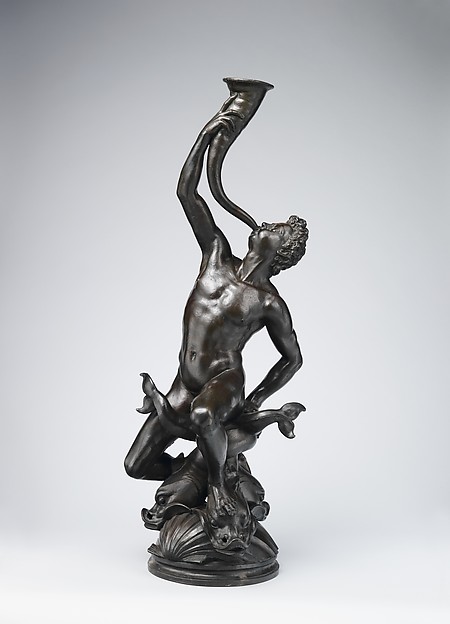
Sed tum, forte cava dum personat aequora concha, demens, et cantu vocat in certamina divos, aemulus exceptum Triton, si credere dignum est, inter saxa virum spumosa inmerserat unda.
Book VI, 170-174
But then, by chance he sounds a hollow sea shell, madly, and the sound calls a contest of a god, the emulation draws out Triton, and if it is worthy to believe, among the rocks the man is drowned in the frothy waves.
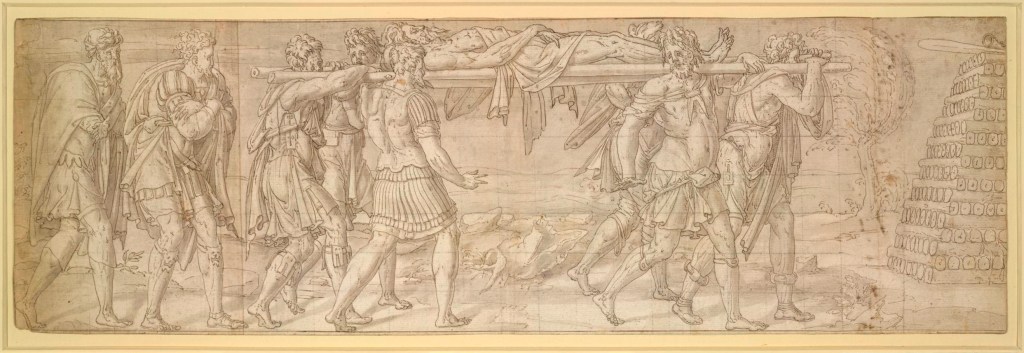
The unfortunate dead in the Aeneid recall the red shirts in Star Trek. The drowning of Misensus contrasts Palinurus’ demise, but seems just as senseless. Worse, when the Sibyl conditions Aeneas progress on the burial of his friend, all Aeneas can think is, “quem socium?” Which friend? Virgil adds to the trumpeters red shirt status with his eyeroll, “if it is worthy to believe.” Two articles about deaths in the Aeneid forget Misensus too. To compensate, Misensus’ funeral is epic. Like Laocoon, Misensus draws attention to himself. I do the same thing. Can an obscure fatality eclipse an ambivalent hero?
Lee Fratantuono, Chiastic Doom in the “Aeneid,” Latomus, T. 68, Fasc. 2 (Juin 2009), pp. 393-401 (9 pages)
E. N. Genovese, Deaths in the “Aeneid,” Pacific Coast Philology, Vol. 10 (Apr., 1975), pp. 22-28 (7 pages)
 Roger Valdez