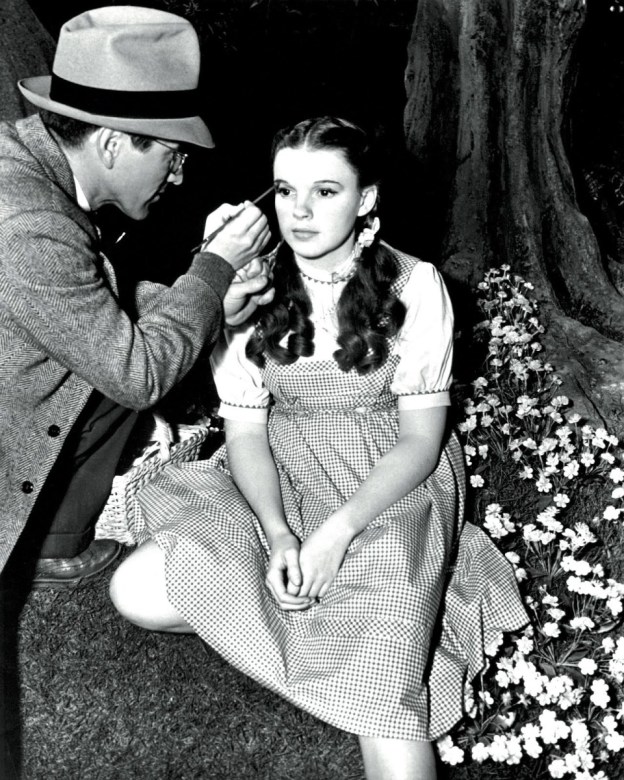
“Thanks for buying me new shoes for the trip,” she said as they bounced along the road from Lebanon to Grand Island.
No problem, honey,” he said. “Remember, when you’re down there and you want to come home to tap the heels three times and say…”
She cut him off.
“That’s just dumb, dad,” she said. “Quit with the Dorothy jokes, jeez.”
“Well, it’s a great movie,” he said.
“I liked the book better,” she said looking out the window, reciting from memory,
“She could see nothing but the great gray prairie on every side. Not a tree nor a house broke the broad sweep of flat country that reached to the edge of the sky in all directions.”
He looked around. And then he looked at her. The truck bounced over rough road.
“That’s pretty damn good,” he said after a while.
“What?” she asked.
“That you remember that,” he said. “Even if you made it up it’s pretty damn good. Kind of scary.”
“What?” she asked again. “I was born with a great memory. And it’s true.” She looked out the passing landscape. “Flat and sky in all directions.”
“I prefer to think of it as a happy movie,” he said. “And you’re riding that tornado to the wizard”
“It’s a bus dad,” she said still looking out the window, “A Greyhound bus.”
“Now you come to me with a simple goodbye,” he started to sing, “you tell me you’re leaving but you won’t tell me why. We’re here at the station and you’re getting on, and all I can think of is . . .” He paused.
She laughed. And then they both sang together.
“Thank God and Greyhound you’re gone!”
“See,” he said, “I remember stuff too, honey.”
She laughed.
“Whatever, dad,” she said. “Just get me to the depot.”
She reached for the radio and turned it on. Reception was hit or miss around here. She found a station. A voice crackled on the old speakers on the truck.
“That was Karla Bonoff with a debut single, Personally, moving into the top 40 from number 45.”
“I hate Casey Kasem,” she said switching stations.
“Out here you take what you can get,” he said. “You know he’s like us, Lebanese.”
She gave him a slide glance and then dialed in another station.
“Hold me now
It’s hard for me I’m sorry
I just want you to stay
After all that we’ve been through
I will make it up to you,
I promise to”
“Hey,” she said, “It’s Chicago. I love this song.”
“I prefer the city to the band,” he said.
The song played between bouts of static.
“Will you ever say you’re sorry?” she asked.
He didn’t respond. He just kept driving.
She had never left Kansas.
She’d never really left Lebanon except for her bike rides beyond the edge of town and trips to Smith Center.
But she’d found out a secret, a lie, and it made her desperate to leave and learn more about who she really was. So now she was going to New Mexico.
Everything had been a lie. The woman she thought was her mother was not. The half-brothers she had weren’t half, but her full-blooded brothers. The truth was her mother, Florence, had died when she was only months old. She said her name to herself when she looked at her dead mother’s picture.
“Florence,” she said. “Florence is your name.”
She would never be able to call her “mother,” or “mama,” or “mommy.” She could never use those universal terms for a woman she couldn’t hug or ask for advice; she’d always call her by her name, as if she could reach her and make her live again.
When she looked in the mirror, she didn’t see the woman she had called her mother. When she looked in the mirror green eyes looked back, and the hair she brushed wasn’t like anything she’d seen or felt on anyone else. It was thick, and dark but reddish. Sometimes she’d pull a hair from her brush and hold it up to the light.
“Momma,” she’d ask. “Why does it look like that, so orangey but black? And why is it so wiggly?”
“Baby, it’s just the way it is,” her mother would say. “It’s how God made you.”
But it wasn’t how God made her. It was how her father and her dead mother made her.
When the stranger from New Mexico appeared and sat in their kitchen, she was afraid. But the way this man looked was so different, yet familiar. She couldn’t stop thinking about him and his visit. Somehow, she knew she didn’t belong. He wasn’t a stranger at all, he was her mom’s younger brother.
And then she couldn’t stop asking questions.
“So, who’s this?” she asked about a picture of the dark-haired woman in a photo album.
Her parents looked at each other, then at her, then at the picture.
“Who is it?” she asked again.
They lied. It’s an aunt. They slapped the album shut. But after a while, days and weeks, they relented. It was her mother. Who was she? Where was she from? Why did she die? How did she die? They had managed to keep it from her and she felt stupid for missing it. And so many of the taunts from other children and her brother made sense now.
All of these questions and thoughts were whipped up like a cyclone when her uncle from New Mexico arrived. And it wasn’t long before the woman she knew as her mother would leave.
“You promised she would be mine,” she said when she left. “That she’d never know. You lied.”
It happened so fast, with no goodbye. Her brother cornered her not long after.
“It’s your fault mom left us,” he growled at her as he grabbed her. “I’ll always hate you.”
Somehow it drove her closer to her dad, and him closer to her. But he never said he was sorry to anyone, for anything.
The bus depot in Grand Island was a brick building and the bus was already waiting.
They finished the rest of the drive without speaking. They sat, each filled with rage, and sadness, and regret watching the prairie pass under the endless sky. It was a lie. Catching parents in a lie was gold. Santa? A lie. Where do babies come from? More lies. Catching parents and adults in a lie meant freedom.
“But she is my mom,” she said with tears when she learned. “My mom is dead?”
They thought they could pull it off. They thought they were far enough away in time. They thought. They thought. And thought.
“Thanks for bringing me,” she finally said while they sat on a bench waiting for the signal to board. “I’ll keep thinking about not hating you, like you said yesterday.”
He laughed and shook his head. He took a flask out of his pocket and took a drink.
“Want a drink?” he asked her. “I mean, you’re 12 but you might as well be older than me.”
She grabbed it from him and took a big swallow, handed it back, and wiped her mouth with her forearm.
“I’ll try,” she said. “I’ll try not hating you.”
The bus wound its way across the flatness of Nebraska to Denver, then Trinidad, and then to Albuquerque.
By Lexington, the buzz had worn off. She wondered to herself, “What am I doing?” Who were these people she was going to see? How could they be her family? Would they accept her?
Her friends were both envious and perplexed by her summer trip. Her father was sometimes the talk of the town, the subject of gossip. Her brothers were always in trouble; handsome boys, but with no plans besides drive-ins and shooting at junk in fields. What else was there to do?
That’s not the life she wanted, and it probably didn’t want her. But what did she want?
There was that spot on 833, at the edge of town, where she’d put the kickstand down and sit next to her bike. Looking down that road she’d wonder what would be at the other end if she just followed it.
Now, here she was on the bus finding out. With every mile she felt like maybe she could be “dissolved into something complete and great.” Other times she was just plain scared.
She occupied herself with a book of puzzles. The book came with a pen that would reveal the answers as she went. The pen was white with an orange cap.
She slept. She read a Choose Your Own Adventure book. She always cheated. She’d look ahead and then choose whatever would keep the story going. “Maybe I’m a liar too,” she thought.
When the bus stopped, she shuffled off with everyone else. Walked down the steps with only her bag. She looked around for the woman she was supposed to meet.
And there she was. The “Wizard,” her grandmother.
She stood with her arms crossed wearing a faded pink gingham dress. It was hot. She stared. Her hair was in a bun. She didn’t move. It was her grandmother, a woman that her father described as one part lamb and two parts lion.
“I’d watch for the lamb,” he warned. “That’s how she’ll get you.”
“Mira que niña hermosa,” she said. “Guera, pero linda.”
Two men were with her.
“Well, well, well,” said one. “Welcome to the Land of Enchantment. You look just like your mom.”
The woman spoke only in Spanish to her uncles as they drove onto Interstate 25. She heard them say her mother’s name over and over as they told stories about her. They’d laugh. Then her grandma would respond sternly and they’d laugh at her. She’d had no idea what they were saying. All the windows were rolled down.
She fell asleep. She heard the song she liked play again.
Hold me now
It’s hard for me I’m sorry
I just want you to know
Hold me now
I really want to tell you I’m sorry
I could never let you go
She dreamt that someday someone would say that to her.
When she woke up, they were passing Camel Rock. It was just that, a rock shaped like a camel. People were parked by it, taking pictures.
 Roger Valdez